How Islamic Economics Redefines the Fight Against Inflation

In a world where price tags seem to change by the hour, inflation is often treated as a mathematical inevitability—a side effect of "growth." However, in Islamic economics, inflation is viewed through a lens of social justice. If the value of money drops, the person holding the cash loses wealth without doing anything wrong.
To keep the system fair and balanced, Islamic economics doesn’t just "manage" inflation; it targets the structural habits that cause it. Here is how the system approaches one of the world's most persistent economic challenges.
Taming the "Debt Genie"
Conventional systems often use debt to solve economic problems, but Islamic finance argues that inflation cannot be tamed without taming debt first.
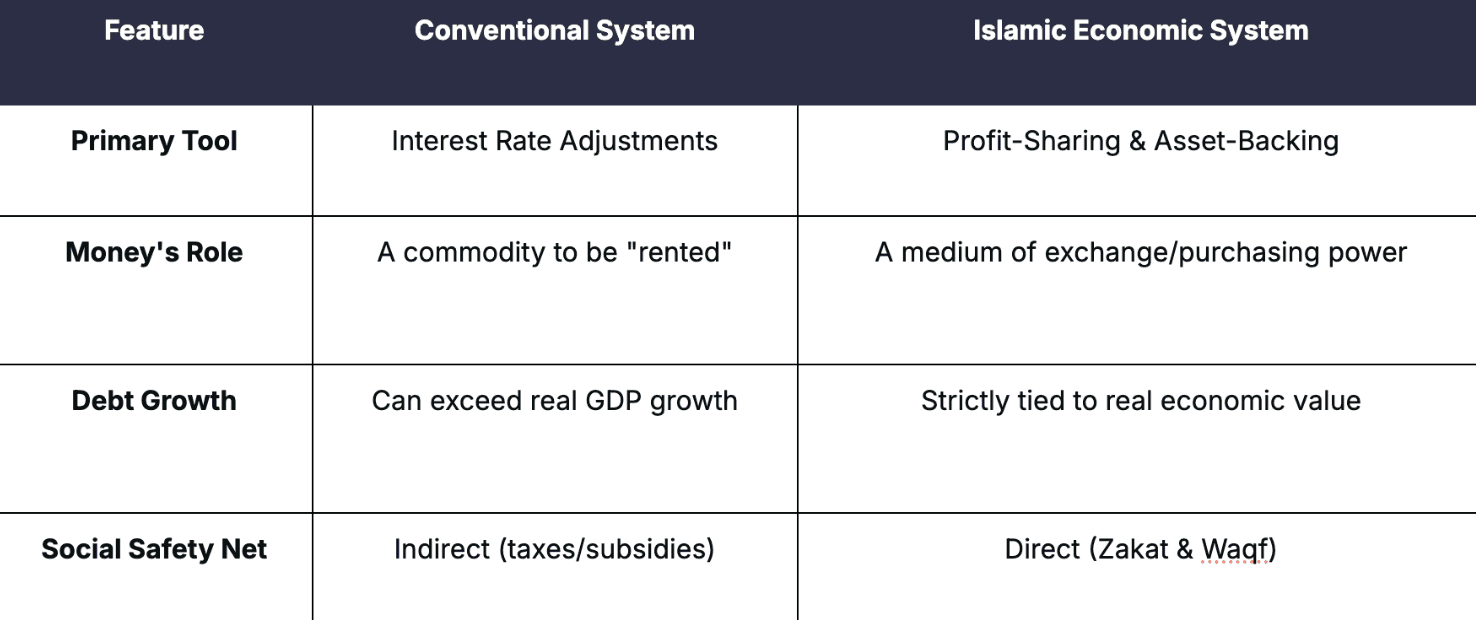
In a standard interest-based system, debt can grow much faster than the actual production of goods. This "decoupling" of money from reality is a primary driver of inflation. Islamic economics requires that all debt be tied to real economic activity (trade or production).
The Difference: You cannot simply "make money from money" (Riba).
The Result: Because every dollar created must be backed by a tangible asset or service, the money supply stays in sync with the supply of goods, naturally cooling inflationary pressure.
Risk-Sharing vs. Fixed Interest
In a typical economy, when inflation rises, central banks hike interest rates. This protects lenders but often crushes small businesses and borrowers who now face higher costs.
Islamic economics uses Profit and Loss Sharing (PLS) models like Mudharabah and Musharakah.
Fairness: Instead of a fixed interest charge that remains the same regardless of the economy, the "cost" of capital fluctuates based on actual profit.
Stability: Research indicates that interest-free funding acts as a stabilizing force. When returns on investment are linked to actual productivity rather than a set percentage, the system avoids the "cost-push" inflation triggered by rising interest expenses.
Key Contrast: Conventional vs. Islamic Inflation Management
Combating "Human-Error" Inflation
Historical Islamic scholars, such as Al-Maqrizi, categorized inflation into two types: Natural (droughts, disasters) and Human-Error (corruption, hoarding, and excessive currency printing).
To combat human-made inflation, the system enforces strict ethical regulations:
Prohibition of Hoarding (Ihtikar): Holding back essential goods to drive up prices is strictly forbidden. This ensures that the "supply" side of the inflation equation remains honest.
The Zakat Effect: Unlike a stagnant tax, Zakat (obligatory charity) encourages the wealthy to keep money circulating in the productive economy rather than hoarding cash, which helps maintain a steady velocity of money.
Stability Through Tangible Value
There is a strong push within Islamic economic thought toward Asset-Backed Finance. By ensuring that currency is either a commodity itself (like the historical gold Dinar) or strictly representative of real-world assets, the system prevents the "unrestrained issuance of fiat money."
When money represents actual purchasing power rather than just a "promise to pay," it retains its value over longer periods, shielding the average person’s savings from being eroded by the printing press.
The Bottom Line
Islamic economics approaches inflation not as a lever to be pulled by a central bank, but as a symptom of a system out of balance. By prohibiting interest, preventing the hoarding of goods, and ensuring every transaction is rooted in the real world, it builds a "built-in stabilizer" designed to protect the most vulnerable from the "inflation tax.